Digital Marketing & SMM Panel: The Complete Guide to Social Media Growth for Indian Businesses
The clothing industry is highly visual, competitive and driven by trends. Whether you operate a fashion startup, boutique, ethnic wear brand, streetwear label, online clothing store, designer brand or D2C fashion business, digital marketing can help you reach potential customers and turn attention into sales.
Today, customers can discover a clothing brand through an Instagram Reel, YouTube Short, influencer recommendation, Google search, WhatsApp conversation or customer review before ever visiting a physical store.
For Indian clothing brands, social media is especially valuable. Meta-commissioned research found that 97% of surveyed fashion shoppers who discover fashion brands on social media find them on Meta platforms, while Instagram Reels play an important role in fashion discovery and purchasing.
This makes digital marketing much more than simply posting photographs of clothes.
A successful clothing brand needs a strategy that combines:
Social Media + Content + Influencers + SEO + Paid Advertising + UGC + Customer Experience + Conversion Optimization
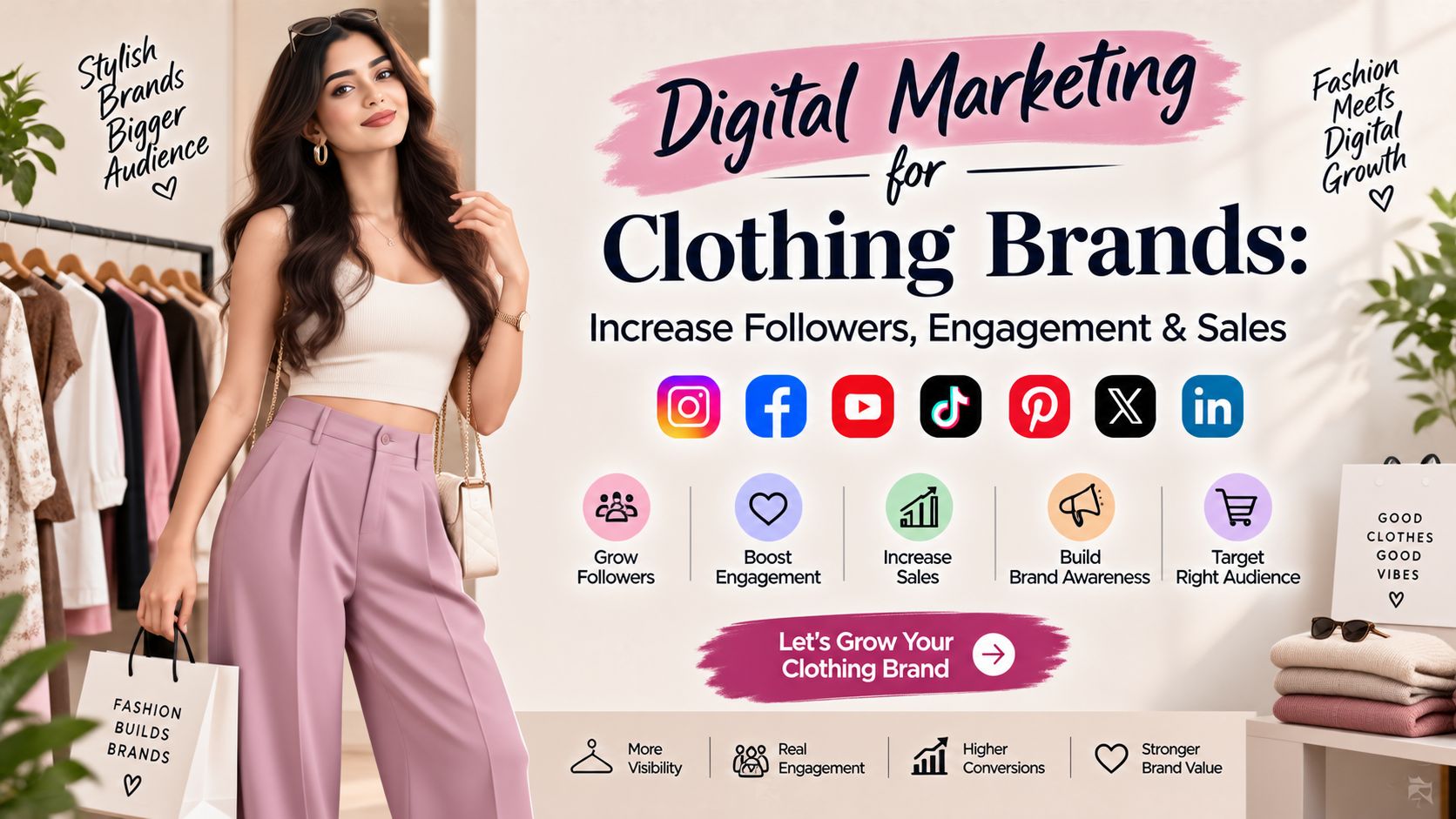
In this guide, we explain how clothing brands can use digital marketing to increase followers, improve engagement and generate more sales.
Why Digital Marketing Is Important for Clothing Brands
Fashion is naturally suited to digital marketing because customers want to see how clothing looks, fits and can be styled.
A strong digital presence allows a clothing brand to:
- Increase brand awareness
- Attract new followers
- Showcase new collections
- Generate engagement
- Promote products
- Build customer trust
- Reach new cities
- Work with influencers
- Generate website traffic
- Increase online orders
- Build repeat customers
The objective isn't simply to make your social media account look attractive.
The objective is to create a marketing system that takes customers from:
Discovery → Interest → Engagement → Trust → Purchase → Repeat Purchase
1. Build a Strong Clothing Brand Identity
Before focusing on followers, define what makes your clothing brand different.
Your branding should be recognizable across:
- Website
- Packaging
- Product photography
- Advertisements
- Marketplace listings
Think about your:
Brand Colors
Logo
Photography Style
Typography
Tone of Voice
Target Customer
Fashion Category
For example, a premium ethnic-wear brand should have a different visual identity from a streetwear brand targeting young customers.
A consistent identity makes your brand easier to recognize.
2. Optimize Your Instagram Profile
For many clothing brands, Instagram acts like a digital storefront.
Your profile should immediately communicate:
What you sell + Who you sell to + Why customers should care + How to shop
Optimize:
- Profile picture
- Username
- Bio
- Website link
- Contact information
- Highlights
- Product categories
- Location information
Create Highlights such as:
- New Arrivals
- Best Sellers
- Reviews
- Size Guide
- Shipping
- Offers
- Collections
- Customer Photos
A visitor should be able to understand your brand within a few seconds.
3. Use Instagram Reels to Increase Reach
Reels should be an important part of a clothing brand's content strategy.
Meta's India research specifically identified Instagram Reels as a major discovery format for fashion shoppers.
Clothing brands can create Reels around:
Outfit Transformations
Show a simple before-and-after styling transformation.
New Collection Reveals
Introduce new products through short videos.
Styling Tips
Show customers different ways to wear the same item.
Behind the Scenes
Show photography, manufacturing, packaging or designing.
Try-On Videos
Show how products look when worn.
Customer Reviews
Turn customer feedback into short videos.
Fashion Inspiration
Create outfit combinations around current customer interests.
The goal is to make the content entertaining and useful rather than making every Reel look like a traditional advertisement.
4. Create Content That People Want to Save and Share
A clothing brand should not publish only product photographs.
Create content that provides value.
Examples include:
- How to style a kurti
- Best outfits for weddings
- Casual outfit ideas
- Office outfit inspiration
- Festival fashion ideas
- Summer styling tips
- Winter layering ideas
- Color combination guides
- How to choose your size
- Fashion mistakes to avoid
- Accessories that match an outfit
Useful content can encourage saves and shares, helping your brand reach people beyond your existing followers.
5. Use High-Quality Product Photography
Clothing is a visual product.
Poor photography can reduce perceived product value.
Your product images should clearly show:
- Fabric
- Color
- Fit
- Texture
- Details
- Front and back
- Close-up features
- Model styling
- Different angles
Don't rely exclusively on heavily edited images.
Customers want to understand what the actual product looks like.
Use a combination of:
Studio Photography + Lifestyle Photography + Model Photography + UGC
This creates a more complete visual experience.
6. Influencer Marketing for Clothing Brands
Influencers can help clothing brands reach highly targeted audiences.
Instead of automatically choosing influencers with the largest follower counts, look at:
- Audience relevance
- Engagement quality
- Content style
- Location
- Fashion niche
- Audience demographics
- Previous brand collaborations
- Conversion potential
A smaller creator with a highly relevant fashion audience may be more useful than a huge general-interest account.
Recent influencer marketing guidance increasingly emphasizes authenticity, niche communities and meaningful engagement rather than follower count alone.
7. Work With Micro-Influencers
Micro-influencers can be particularly useful for clothing brands.
For example, a clothing company could collaborate with creators focused on:
- Indian ethnic fashion
- Streetwear
- Modest fashion
- Wedding fashion
- College fashion
- Men's fashion
- Women's fashion
- Plus-size fashion
- Sustainable fashion
- Regional fashion
You can provide products for creators to style and review, or develop paid collaborations.
Always establish clear expectations and appropriate disclosure for paid partnerships.
8. Build User-Generated Content
Customer-generated content can become one of your strongest marketing assets.
Encourage customers to share:
- Outfit photographs
- Unboxing videos
- Styling videos
- Reviews
- Reels
- Testimonials
- Event looks
With appropriate permission, feature this content on your social media channels.
UGC provides social proof and helps potential customers see how your products look outside a professional photoshoot.
9. Showcase Customer Reviews
Fashion customers often want reassurance before purchasing.
Reviews can answer questions such as:
- Is the size accurate?
- Is the fabric good?
- Does the product look like the photograph?
- How is the fitting?
- Was delivery satisfactory?
- Is the product worth the price?
Create a dedicated Reviews Highlight on Instagram.
You can also turn positive reviews into:
- Instagram posts
- Reels
- Stories
- Website testimonials
- Product-page content
- Advertisements
10. Use Instagram Stories for Daily Engagement
Reels are useful for discovery, while Stories can help maintain relationships with existing followers.
Use Stories for:
- Polls
- Questions
- Product previews
- New arrivals
- Behind-the-scenes content
- Customer reviews
- Limited offers
- Restocks
- Size information
- Countdown stickers
Stories can make your brand feel active and accessible.
11. Create Fashion-Focused Content Pillars
A strong content strategy can use five main pillars.
1. Product Content
Show your clothing and collections.
2. Educational Content
Teach customers about styling, sizing and fashion.
3. Lifestyle Content
Show how your products fit into everyday life.
4. Social Proof
Share reviews, UGC and influencer content.
5. Promotional Content
Highlight launches, offers and collections.
This prevents your Instagram page from becoming a continuous stream of sales posts.
12. Use SEO for Clothing Brands
Search engine optimization can help customers discover your clothing business when they are actively searching.
Optimize your website for keywords such as:
- Women's clothing online
- Men's clothing online
- Indian ethnic wear
- Designer sarees
- Kurti online
- Streetwear India
- Women's dresses
- Men's fashion
- Wedding outfits
- Fashion boutique
- Clothing brand India
Create useful blog content around fashion-related searches.
For example:
Best Wedding Outfit Ideas for Indian Women
How to Style a Kurti for Different Occasions
Best Casual Outfits for College Students
How to Choose the Right Dress Size Online
SEO can create long-term traffic beyond social media.
13. Optimize Your Product Pages
Driving traffic to your website is only half the job.
Your product pages need to convert visitors into customers.
Include:
- High-quality images
- Product videos
- Detailed descriptions
- Fabric information
- Size chart
- Delivery information
- Return policy
- Customer reviews
- Product availability
- Clear pricing
- Strong call-to-action
Avoid descriptions that only say:
“Beautiful premium dress.”
Explain what actually makes the product valuable.
14. Use WhatsApp Marketing
WhatsApp can be useful for customer communication and sales support.
Clothing brands can use WhatsApp for:
- Product inquiries
- Size assistance
- Order updates
- New collection announcements
- Customer support
- Personalized recommendations
- Restock notifications
For example, a customer asking about the right size can receive personalized assistance before completing an order.
Use permission-based communication and avoid sending unwanted promotional messages.
15. Run Paid Ads for Clothing Products
Organic content can build awareness, while paid advertising can help clothing brands reach specific audiences.
Platforms such as Meta Ads can be used to promote:
- New collections
- Best sellers
- Seasonal products
- Offers
- Product catalogs
- Retargeting campaigns
Fashion advertising works particularly well when the creative looks like native social content rather than a traditional advertisement.
Test different:
- Videos
- Models
- Hooks
- Product angles
- Offers
- Audiences
- Calls to action
Then invest more in creatives that generate meaningful business results.
16. Retarget Website Visitors
Not everyone purchases after the first visit.
A customer may:
- View a product
- Add it to cart
- Check the size chart
- Leave the website
- Return later
Retargeting can remind interested customers about products they previously viewed.
Potential retargeting audiences include:
- Website visitors
- Product viewers
- Cart abandoners
- Instagram engagers
- Video viewers
- Previous customers
Use relevant messaging rather than repeatedly showing the same advertisement.
17. Promote New Collections Properly
Don't launch a collection with one product post.
Create anticipation.
Before Launch
Use:
- Teasers
- Behind-the-scenes content
- Countdown Stories
- Close-up product shots
- Influencer previews
Launch Day
Use:
- Reels
- Product photographs
- Stories
- Website promotion
- Influencer content
- Paid advertisements
After Launch
Use:
- Customer reviews
- Styling videos
- UGC
- Best-seller posts
- Restock announcements
This turns a product launch into a campaign.
18. Use Festival and Seasonal Marketing
Indian clothing brands have enormous opportunities around cultural and seasonal occasions.
Plan campaigns around relevant events such as:
- Diwali
- Eid
- Holi
- Navratri
- Durga Puja
- Pongal
- Onam
- Wedding season
- Valentine's Day
- Independence Day
- Regional festivals
Create campaigns that connect the occasion with your products rather than simply adding a festival greeting to a product photograph.
19. Regional Marketing for Indian Clothing Brands
India is not one uniform fashion market.
Different regions have different:
- Languages
- Fashion preferences
- Festivals
- Climate
- Cultural traditions
- Shopping behavior
A clothing brand can create location-specific campaigns.
Examples:
Ethnic Wear for Hyderabad Weddings
Sarees for Chennai Customers
Winter Fashion for Delhi
Wedding Fashion for Mumbai
Traditional Wear for Kolkata
Location-specific content can help brands connect with local audiences.
20. Build a Strong Pinterest and YouTube Strategy
Don't depend entirely on Instagram.
Pinterest can help with visual fashion discovery, while YouTube can support longer educational and styling content.
YouTube ideas include:
- Lookbooks
- Styling guides
- Fashion hauls
- Product reviews
- Behind-the-scenes videos
- Collection launches
- Fashion tutorials
- Designer interviews
YouTube Shorts can also repurpose successful short-form content.
21. Increase Followers the Right Way
Follower growth should be connected to your target customer.
Focus on attracting people who are actually interested in fashion and your product category.
Strategies include:
- Reels
- Influencer collaborations
- Giveaways with relevant audiences
- UGC campaigns
- SEO
- Cross-platform promotion
- Paid social advertising
- Fashion communities
- Consistent posting
The objective is not simply:
More Followers
It is:
More Relevant Followers → More Engagement → More Website Visits → More Customers
22. Increase Engagement
Engagement can help build a stronger relationship between your brand and audience.
Try:
- Asking questions
- Creating polls
- Responding to comments
- Replying to DMs
- Sharing customer posts
- Creating interactive Stories
- Asking followers to choose between outfits
- Running styling challenges
For example:
“Which look would you wear for a wedding — Look A or Look B?”
This is more engaging than simply writing:
“Shop our new collection.”
23. Use Social Media Services Carefully
Some clothing brands and agencies may use SMM services to support certain social media promotional activities.
An SMM panel can provide services related to platforms such as Instagram, YouTube, Facebook and Telegram.
These services should complement a real marketing strategy rather than replace it.
The strongest approach combines:
Quality Content + Influencers + SEO + Paid Ads + UGC + Customer Engagement + Social Media Services
Don't judge your marketing only by follower numbers.
Track meaningful business metrics such as:
- Website traffic
- Product views
- Add-to-cart rate
- Orders
- Revenue
- Repeat purchases
- Customer acquisition cost
- Return on ad spend
24. Create a Clothing Brand Content Calendar
A simple weekly content plan could look like:
Monday
Fashion tip Reel
Tuesday
Product photograph or carousel
Wednesday
Customer review
Thursday
Styling Reel
Friday
Behind-the-scenes Story
Saturday
Influencer/UGC content
Sunday
New collection or promotional content
You can adapt the schedule according to your audience and analytics.
Consistency is more important than trying to post every possible type of content.
25. Track the Right Metrics
Don't focus only on follower growth.
Track:
Social Media Metrics
- Followers
- Reach
- Engagement
- Saves
- Shares
- Comments
- Video views
- Profile visits
Website Metrics
- Traffic
- Product views
- Add-to-cart rate
- Checkout rate
- Conversion rate
Business Metrics
- Orders
- Revenue
- Customer acquisition cost
- Repeat purchase rate
- Average order value
- Return on advertising spend
This helps you understand which marketing activities are actually contributing to business growth.
26. Common Digital Marketing Mistakes Clothing Brands Make
Only Posting Product Photos
Customers need inspiration and useful content.
Focusing Only on Followers
A smaller relevant audience can generate more sales than a large inactive audience.
Ignoring Video
Fashion is highly visual and video can demonstrate products effectively.
Choosing Influencers Only by Follower Count
Audience relevance and engagement matter.
Using Poor Product Photography
Visual quality strongly affects perceived product value.
Running Ads Without Testing Creatives
Test different creative concepts before scaling.
Ignoring Customer Reviews
Social proof can help reduce purchase hesitation.
Making Every Post Promotional
Balance selling with education, entertainment and storytelling.
27. Digital Marketing Strategy for New Clothing Brands
If you are launching a new clothing brand, start with a focused strategy.
Phase 1: Branding
Define your:
- Target customer
- Product category
- Brand identity
- Price positioning
- Visual style
Phase 2: Content
Create:
- Product photographs
- Reels
- Styling videos
- UGC
- Educational content
Phase 3: Audience Building
Use:
- Influencers
- Reels
- Social media
- SEO
- Community engagement
Phase 4: Sales
Introduce:
- Website optimization
- Paid ads
- Retargeting
- WhatsApp support
- Product offers
Phase 5: Retention
Encourage:
- Reviews
- Repeat purchases
- Referral marketing
- UGC
- Customer communities
This creates a complete customer journey.
Why Digitallov.com for Clothing Brand Marketing?
Digitallov.com can be part of a clothing brand's wider social media marketing strategy.
Fashion businesses can combine social media services with:
- Instagram marketing
- Facebook marketing
- YouTube promotion
- Social media growth
- Content promotion
- Brand awareness
- Audience growth
- Digital marketing
- Influencer campaigns
For a clothing brand, the goal should be more than increasing social media numbers.
The ultimate objective is to build a recognizable fashion brand that attracts relevant customers and converts attention into sales.
Final Thoughts
Digital marketing has become essential for clothing brands that want to compete online.
A successful fashion marketing strategy combines Instagram Reels, high-quality photography, influencer marketing, user-generated content, SEO, paid advertising, WhatsApp communication, customer reviews and consistent social media engagement.
Don't focus only on getting more followers.
Focus on getting the right followers.
Don't focus only on getting likes.
Focus on creating content people want to save, share and remember.
And don't focus only on generating website traffic.
Focus on creating an experience that turns visitors into customers and customers into repeat buyers.
For clothing brands looking for affordable social media marketing solutions, Digitallov.com can be included as part of a broader digital marketing strategy.
Build your brand. Grow your audience. Increase engagement. Turn attention into fashion sales.