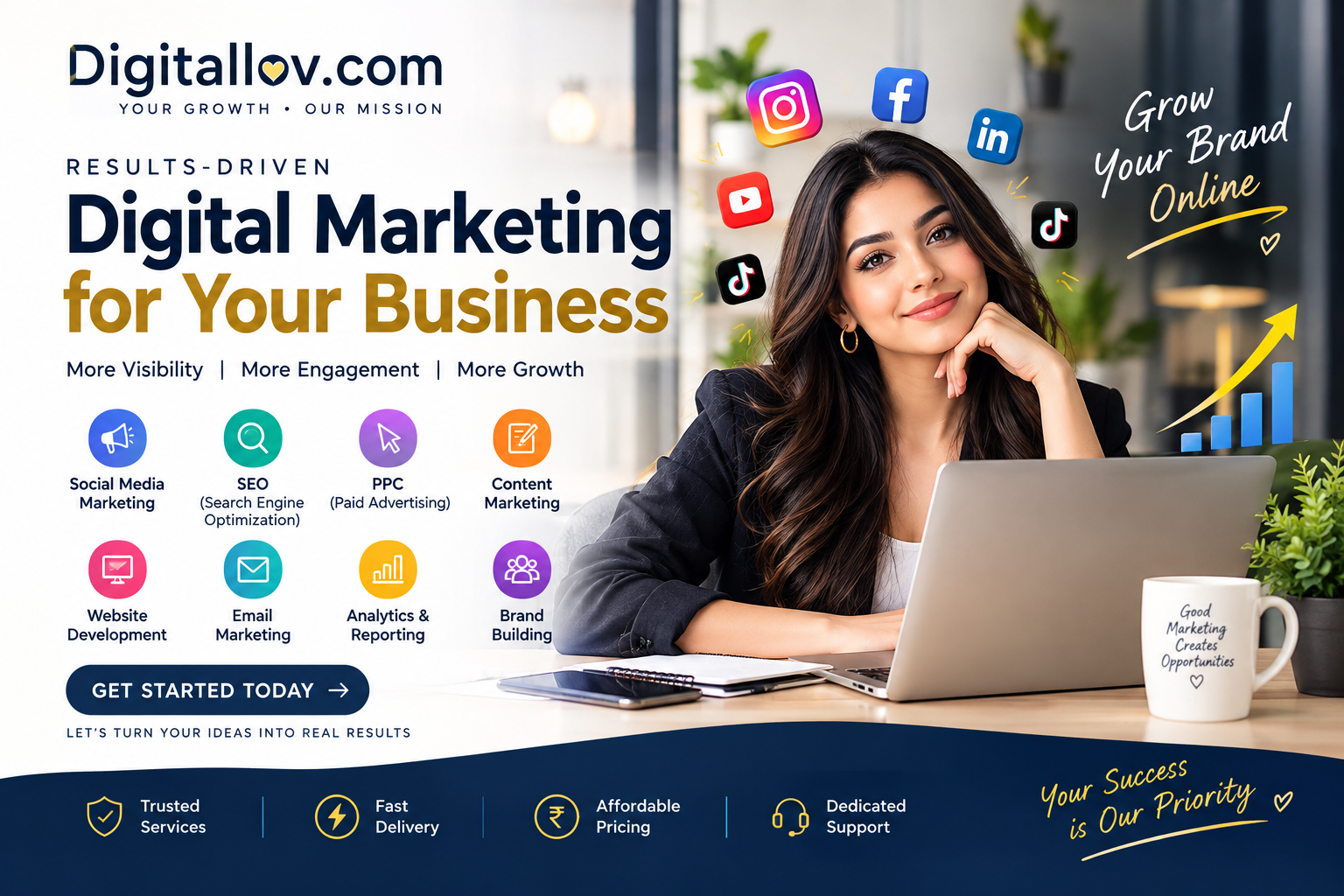
Businesses today need more than online visibility. They need marketing campaigns that contribute to measurable business results.
This is where performance marketing services in India can help businesses create more focused and measurable digital marketing campaigns. Instead of concentrating only on impressions, likes, or general reach, performance marketing focuses on outcomes such as leads, sales, conversions, customer acquisition, and return on advertising spend.
Modern performance marketing can combine paid search, social media advertising, display advertising, remarketing, landing page optimization, analytics, and conversion optimization. Data is then used to understand campaign performance and continuously improve results.
For businesses in India, this approach can be particularly useful when marketing budgets need to be managed carefully and campaigns need to be evaluated based on measurable objectives.
At Digitallov.com, businesses can explore digital marketing solutions focused on improving online visibility, customer acquisition, lead generation, and business growth.
What Is Performance Marketing?
Performance marketing is a data-driven form of digital marketing where campaigns are measured against specific business outcomes.
Depending on the business, these outcomes can include:
- Website leads
- Product sales
- App installations
- Online purchases
- Form submissions
- Phone calls
- Qualified inquiries
- Customer acquisition
- Conversions
- Revenue
The exact performance indicators depend on the campaign's objective.
For an e-commerce company, sales and revenue may be the primary goals. For a real estate company, qualified leads may be more important. For a service business, phone calls, contact forms, or consultation bookings could be the main conversion.
This makes performance marketing flexible for different industries and business models.
Why Performance Marketing Services Are Important in India
India has a highly competitive digital marketplace. Businesses across industries are competing for attention through Google, social media, websites, marketplaces, and other digital platforms.
Simply running advertisements is not enough.
Businesses need to understand:
- Who they are targeting
- Which platforms perform best
- Which advertisements generate conversions
- Which audiences are profitable
- How much each customer costs
- Which landing pages convert
- Where potential customers leave the buying journey
Performance marketing uses data and ongoing optimization to answer these questions.
Key Performance Marketing Services
A complete performance marketing strategy can include several services working together.
1. Google Ads Management
Google Ads can help businesses reach users who are actively searching for products and services.
Campaigns can include:
- Search Ads
- Display Ads
- Shopping Ads
- YouTube Ads
- Performance Max campaigns
- Remarketing
Search advertising can be especially valuable because it allows businesses to reach users based on their search intent.
For example, someone searching for a specific service in their city may already have a strong intention to purchase or make an inquiry.
2. Meta Ads Management
Facebook and Instagram advertising can help businesses reach targeted audiences using different campaign formats.
Meta advertising can support:
- Lead generation
- Product sales
- Website conversions
- Brand promotion
- Retargeting
- Catalog advertising
- Customer acquisition
Creative testing is an important part of social media performance marketing because different images, videos, messages, and offers can produce different results.
3. Lead Generation Campaigns
Lead generation is a major objective for many businesses.
Performance marketing campaigns can be designed to generate inquiries from potential customers.
Lead-generation campaigns may be useful for:
- Real estate
- Education
- Healthcare
- Financial services
- Professional services
- B2B companies
- Local businesses
- Home services
However, generating a large number of leads is not always enough.
Businesses should focus on qualified leads that have a genuine possibility of becoming customers.
4. E-commerce Performance Marketing
E-commerce businesses can use performance marketing to promote products and generate online purchases.
Campaigns can focus on:
- Product discovery
- Product advertising
- Shopping campaigns
- Catalog campaigns
- Remarketing
- Cart recovery
- Customer acquisition
- Repeat purchases
Performance marketing can also help e-commerce brands identify which products, audiences, and campaigns generate the strongest returns.
5. Remarketing and Retargeting
Many visitors do not purchase during their first visit to a website.
Remarketing allows businesses to reconnect with people who have already interacted with their website, products, advertisements, or other digital properties.
For example, someone may view a product but leave without purchasing. A properly configured retargeting campaign can help bring that potential customer back.
This can be particularly useful for products or services that require consideration before purchase.
6. Conversion Rate Optimization
Getting traffic is only one part of digital marketing.
Businesses also need to make sure their website or landing page converts visitors into customers or leads.
Conversion rate optimization can involve improving:
- Headlines
- Calls to action
- Forms
- Landing pages
- Product pages
- Website navigation
- Page speed
- Mobile experience
- Trust signals
- Checkout experience
A better conversion rate can allow businesses to generate more results from existing traffic.
7. Landing Page Optimization
A landing page should match the advertisement or search intent that brought the visitor there.
For example, if an advertisement promotes a particular service, sending visitors to a generic homepage may create unnecessary friction.
A focused landing page can include:
- Clear service information
- Strong value proposition
- Relevant visuals
- Customer benefits
- Trust signals
- Testimonials
- Frequently asked questions
- Simple contact forms
- Strong calls to action
8. Performance Tracking and Analytics
Data is at the center of performance marketing.
Businesses can monitor metrics such as:
- Click-through rate
- Conversion rate
- Cost per click
- Cost per lead
- Customer acquisition cost
- Return on ad spend
- Revenue
- Conversion volume
- Website engagement
These metrics help marketers understand which campaigns are working and where improvements are required.
Performance Marketing vs Traditional Digital Marketing
Performance marketing differs from broad digital marketing mainly in its emphasis on measurable outcomes.
Traditional digital marketing strategies may focus heavily on visibility, awareness, content, or engagement.
Performance marketing can include these elements but connects them more closely to measurable business objectives.
For example:
Traditional focus:
Increase social media reach.
Performance focus:
Generate qualified leads from social media at an acceptable cost.
Neither approach is automatically better for every situation. Brand awareness can be important for long-term growth, while performance campaigns can be useful when businesses need measurable acquisition results.
A strong marketing strategy can combine both.
Benefits of Performance Marketing Services in India
Measurable Results
One of the biggest advantages of performance marketing is the ability to track campaign results.
Businesses can see where their marketing budget is going and what outcomes are being generated.
Better Budget Control
Campaigns can be adjusted based on performance.
Businesses can increase investment in stronger campaigns and reduce spending on campaigns that are not meeting their objectives.
Targeted Customer Acquisition
Digital advertising platforms provide detailed targeting options that can help businesses reach relevant audiences.
Continuous Optimization
Performance marketing is not simply about launching a campaign and leaving it unchanged.
Campaigns can be continuously tested and optimized based on data.
Scalable Growth
When a campaign consistently generates profitable results, businesses can potentially increase budgets and expand successful campaigns.
However, scaling should be done carefully because increasing advertising spend does not automatically guarantee the same return.
Performance Marketing for Small Businesses
Small businesses often have limited advertising budgets.
Performance marketing can help them focus their spending on specific goals rather than attempting to reach everyone.
For example, a local business could target customers in selected cities or service areas, while an online store could focus its advertising budget on products with strong demand.
A smaller budget can still be useful when campaigns are carefully targeted and continuously optimized.
Performance Marketing for Startups
Startups need to acquire customers while learning which marketing messages and audiences work best.
Performance campaigns can provide useful data about:
- Customer interests
- Best-performing audiences
- Effective offers
- Ad creatives
- Search terms
- Landing pages
- Customer acquisition costs
This information can help startups refine their broader marketing strategy.
Performance Marketing for E-commerce Businesses
For e-commerce brands, performance marketing can connect advertising activity with online purchases.
A typical customer journey might look like:
Advertisement → Product Page → Add to Cart → Checkout → Purchase
Marketers can measure each stage of this journey and identify where customers are dropping off.
If many users click an advertisement but few purchase, the problem may not be the advertisement itself. It could be the product page, pricing, checkout process, trust factors, or another part of the customer experience.
This is why effective performance marketing often goes beyond advertising campaign management.
How a Performance Marketing Strategy Works
A structured performance marketing campaign generally follows several stages.
Step 1: Define the Objective
First, identify what the campaign needs to achieve.
Examples include:
- 100 qualified leads
- More online purchases
- Lower customer acquisition cost
- Higher revenue
- More service inquiries
Step 2: Identify the Target Audience
Understand who the ideal customer is and where they spend time online.
Step 3: Select Marketing Channels
Choose appropriate platforms based on customer behavior and campaign objectives.
Step 4: Create Campaign Assets
Develop advertisements, landing pages, offers, images, videos, and other creative assets.
Step 5: Launch and Track
Once campaigns are launched, performance data should be monitored regularly.
Step 6: Test and Optimize
Different audiences, messages, creatives, offers, and landing pages can be tested to identify stronger combinations.
Step 7: Scale Successful Campaigns
When a campaign demonstrates consistent performance, businesses can consider increasing investment while monitoring efficiency.
Important Performance Marketing Metrics
Understanding performance metrics is essential for making informed decisions.
Cost Per Lead
CPL measures how much it costs to generate a lead.
Cost Per Acquisition
CPA measures the cost of acquiring a customer or desired conversion.
Return on Ad Spend
ROAS compares revenue generated from advertising with the amount spent on advertising.
Conversion Rate
Conversion rate measures the percentage of users who complete a desired action.
Customer Acquisition Cost
CAC measures the overall cost associated with acquiring customers.
These metrics should be interpreted according to the business model rather than viewed in isolation.
Common Performance Marketing Mistakes
Businesses can waste advertising budgets when campaigns are not properly planned or monitored.
Common mistakes include:
Launching Ads Without Tracking
Without accurate conversion tracking, it can be difficult to know whether advertising is actually generating business results.
Focusing Only on Clicks
A high number of clicks does not necessarily mean a campaign is successful.
The quality of traffic and resulting conversions are often more important.
Using the Same Creative for Too Long
Ad fatigue can reduce campaign effectiveness. Regular creative testing can help identify new opportunities.
Ignoring Landing Pages
Even excellent advertisements may perform poorly when visitors arrive on confusing or irrelevant landing pages.
Scaling Too Quickly
Increasing the budget too aggressively can change campaign efficiency. Scaling should be based on reliable performance data.
Why Choose Digitallov.com?
Digitallov.com provides digital marketing solutions designed to help businesses strengthen their online presence and improve customer acquisition.
Performance-focused marketing can combine paid advertising, social media marketing, search marketing, landing page optimization, conversion strategies, and analytics.
The objective is to create campaigns that are aligned with measurable business goals rather than focusing only on surface-level engagement.
Whether you are a startup, small business, e-commerce brand, local company, or established organization, a performance-focused digital marketing strategy can help you make more informed marketing decisions.
Conclusion
Performance Marketing Services India can help businesses move toward a more measurable and data-driven approach to digital marketing.
From Google Ads and Meta Ads to lead generation, e-commerce advertising, remarketing, landing page optimization, conversion rate optimization, and analytics, performance marketing provides businesses with multiple ways to connect advertising activity with measurable outcomes.
The most successful campaigns are not simply about spending more money on advertisements. They depend on the right audience, compelling creative, accurate tracking, effective landing pages, continuous testing, and ongoing optimization.
For businesses looking to improve customer acquisition and build a stronger digital growth strategy, Digitallov.com can be a starting point for exploring professional digital marketing solutions.